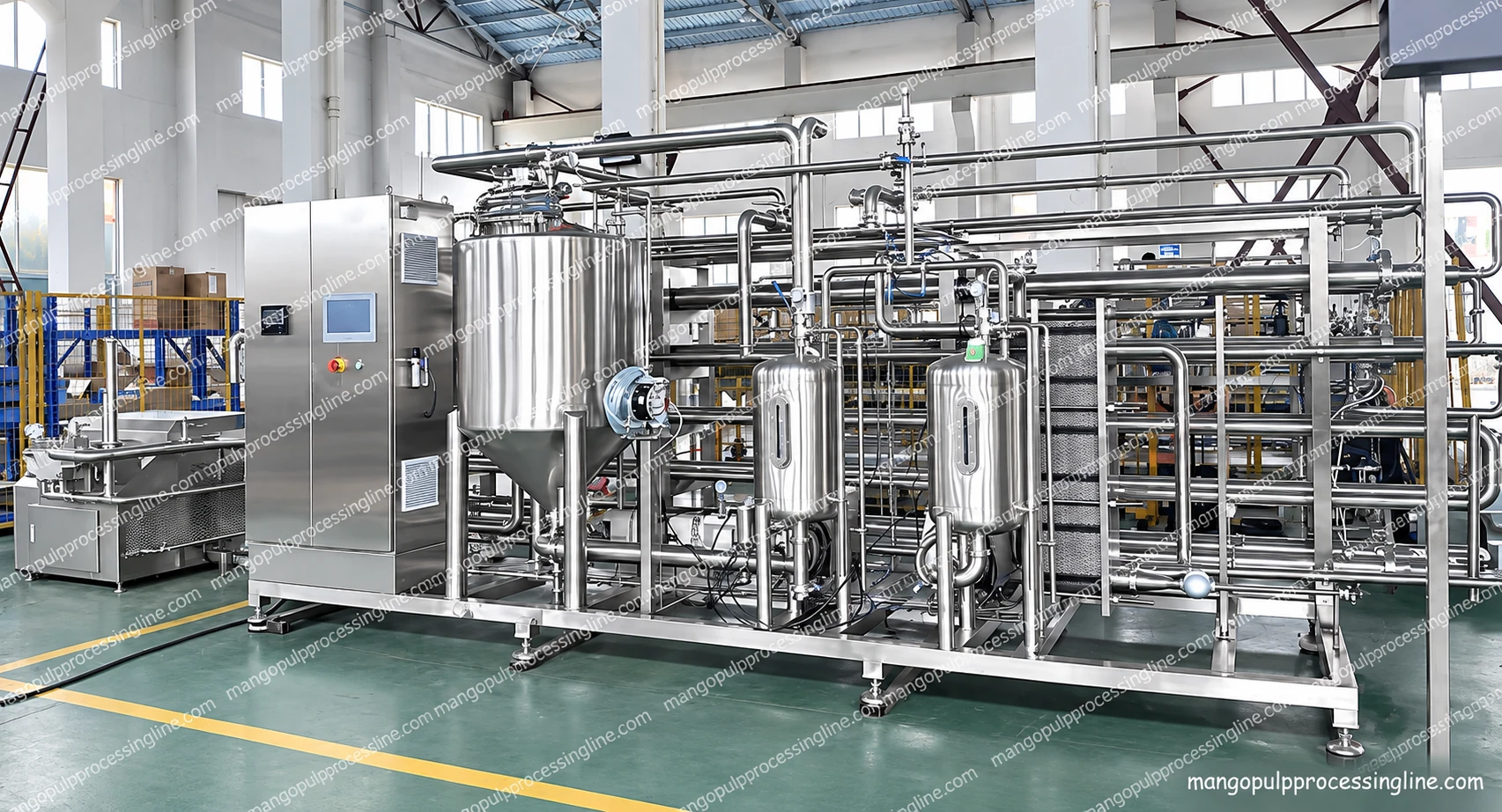
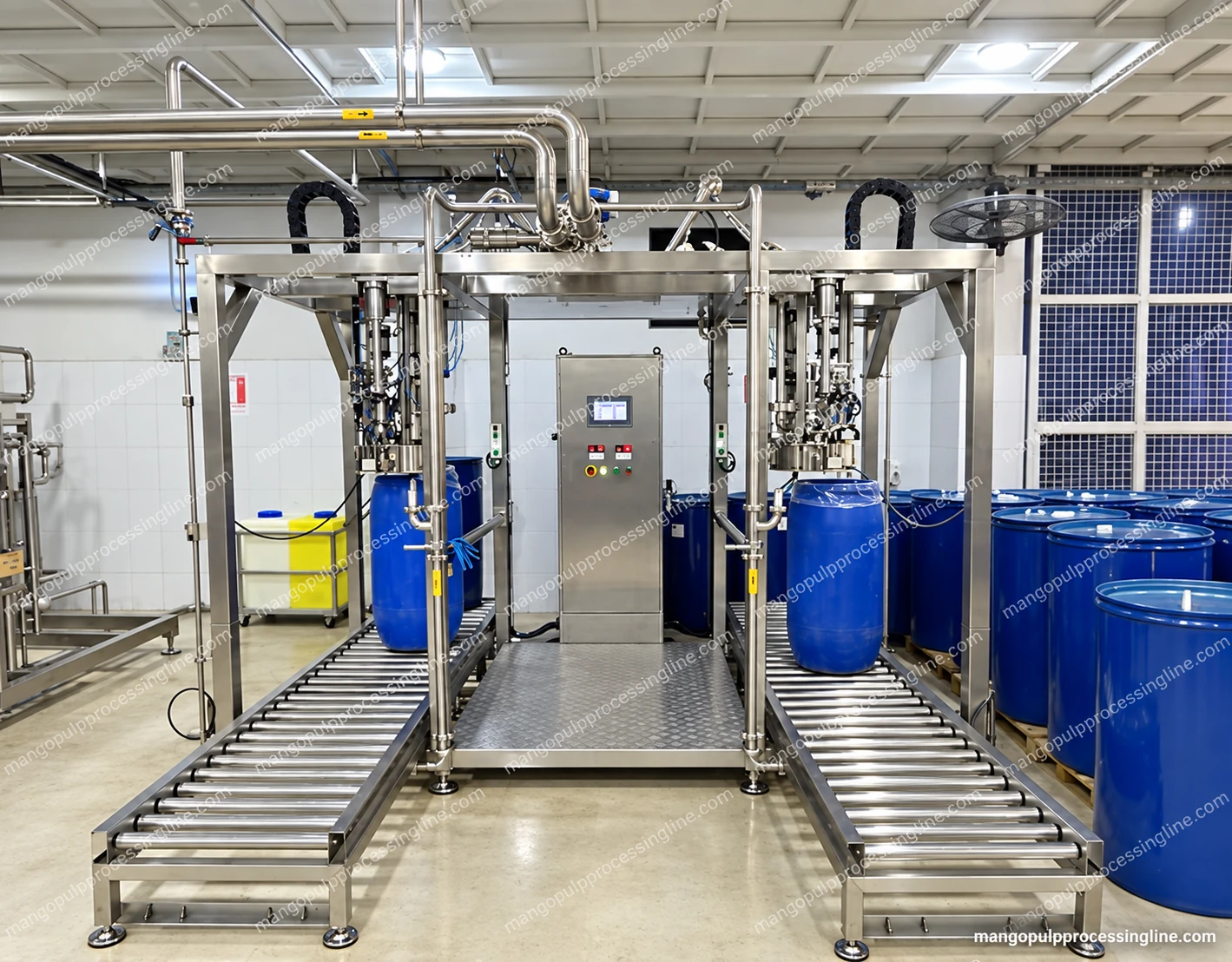
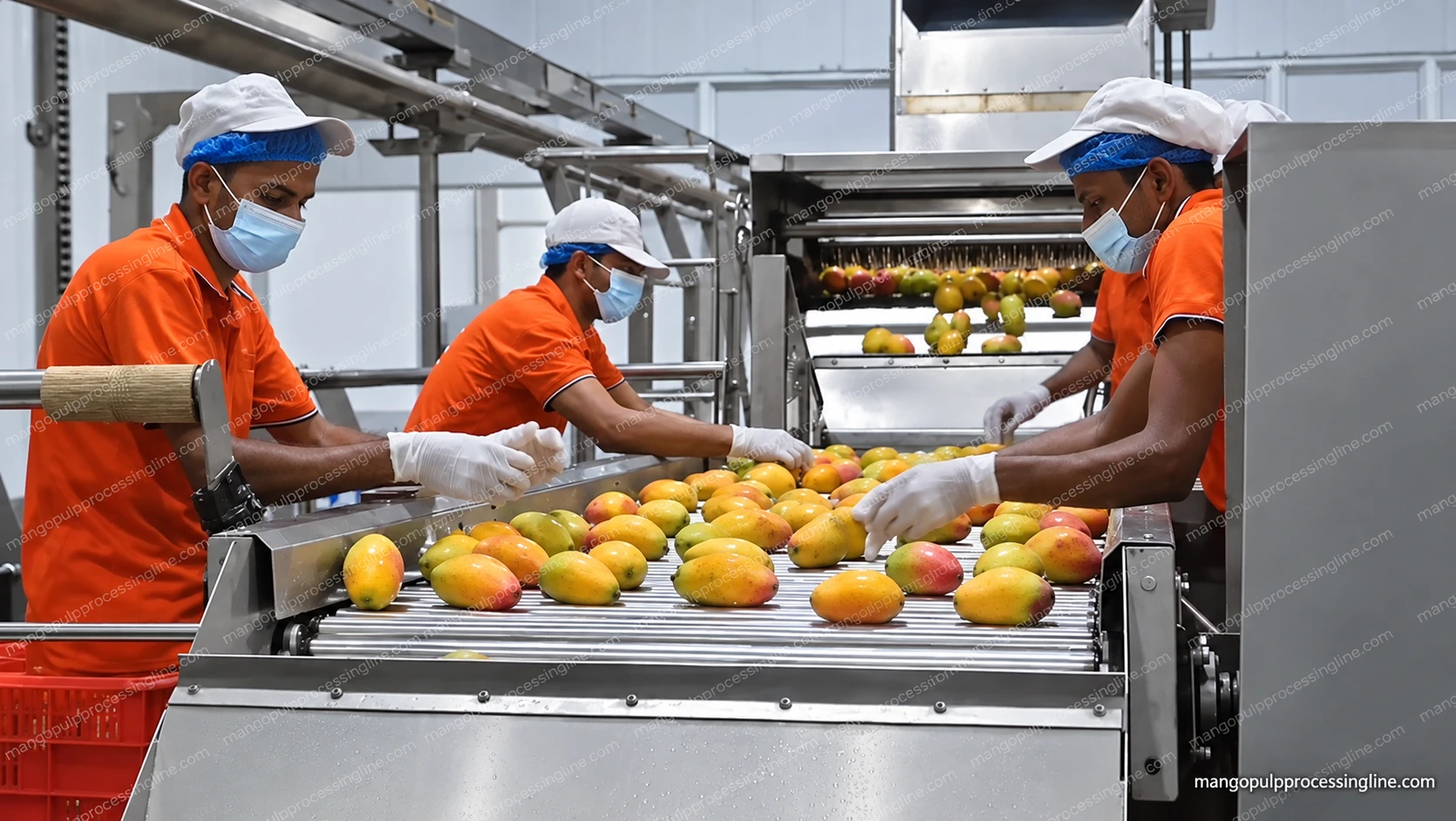
Four different quantities on one line
A model-family processing rate and the output of a complete mango line describe different scopes. Downstream sizing must begin with the material that reaches that stage, including the selected refining and concentration route.
| Quantity | Typical expression | Meaning |
|---|---|---|
| Fresh-fruit handling | t/h or kg/h | Whole fruit crossing the stated receiving or machine-feed boundary |
| Pulp flow | kg/h or L/h | Accepted pulp at a stated stage and product condition |
| Evaporation duty | kg of water/h | Water removed from the pulp within the evaporation section |
| Packaged production | kg per run, packs/h or stated fill volume | Product actually filled during the measured operating period |
Measure recovery at a named boundary
For an extraction test, distinguish received fruit from accepted fruit after sorting. Then collect pulp, stones/peel and refining rejects separately over a matched period. Record product retained in equipment at the start and end; otherwise a short test can appear to lose or gain material simply because the line is filling or draining.
Mass-based pulp recovery (%) = collected accepted pulp mass ÷ fruit mass at the stated boundary × 100. The numerator and denominator must describe the same test, before dilution or concentration. State whether the denominator is all received fruit or only the accepted feed.
Where ingredients or water are added, include them separately. For a defined process boundary: incoming mass + opening retained mass = outgoing mass + closing retained mass. The outgoing total includes product, collected rejects, evaporation where applicable and other measured losses. An unexplained balance difference calls for investigation rather than a new yield claim.
Convert pulp flow with product density
Mass flow (kg/h) = volume flow (L/h) × density (kg/L). Density belongs to the actual product at the stated condition. Treating every litre of pulp as one kilogram silently changes the material balance.
Research on mango puree has measured changes in density and flow properties with concentration and temperature. For equipment matching, use measured or otherwise applicable product data instead of transferring a value from a different recipe or test condition.
Calculate evaporation from the feed and target concentrate
Removing water reduces the mass of product continuing downstream. A concentration balance therefore needs the pulp feed, the concentrate leaving the system and the water removed; it does not use whole-fruit throughput as an evaporation rate.
For a simplified balance that conserves the chosen dry-solids measure and excludes other additions or losses, concentrate mass = feed mass × feed solids fraction ÷ concentrate solids fraction. Water removed = feed mass − concentrate mass. Both solids fractions must use the same measurement basis. A soluble-solids reading alone does not account for all insoluble fruit material in puree.
Connect equipment duty to the production window
Production time includes start-up, stopping, bag handling, product changes and cleaning as well as steady running. Multiplying a nominal machine rate by the full shift length assumes that the machine processes at that rate throughout the shift. Use the expected operating periods and actual line constraints to distinguish running duty from planned packed output.