The filling head and the bag form one interface
Each filling position connects the product path to a compatible aseptic bag fitment. The head arrangement handles the specified opening, filling and closing sequence, while the surrounding drum-handling equipment positions the container.
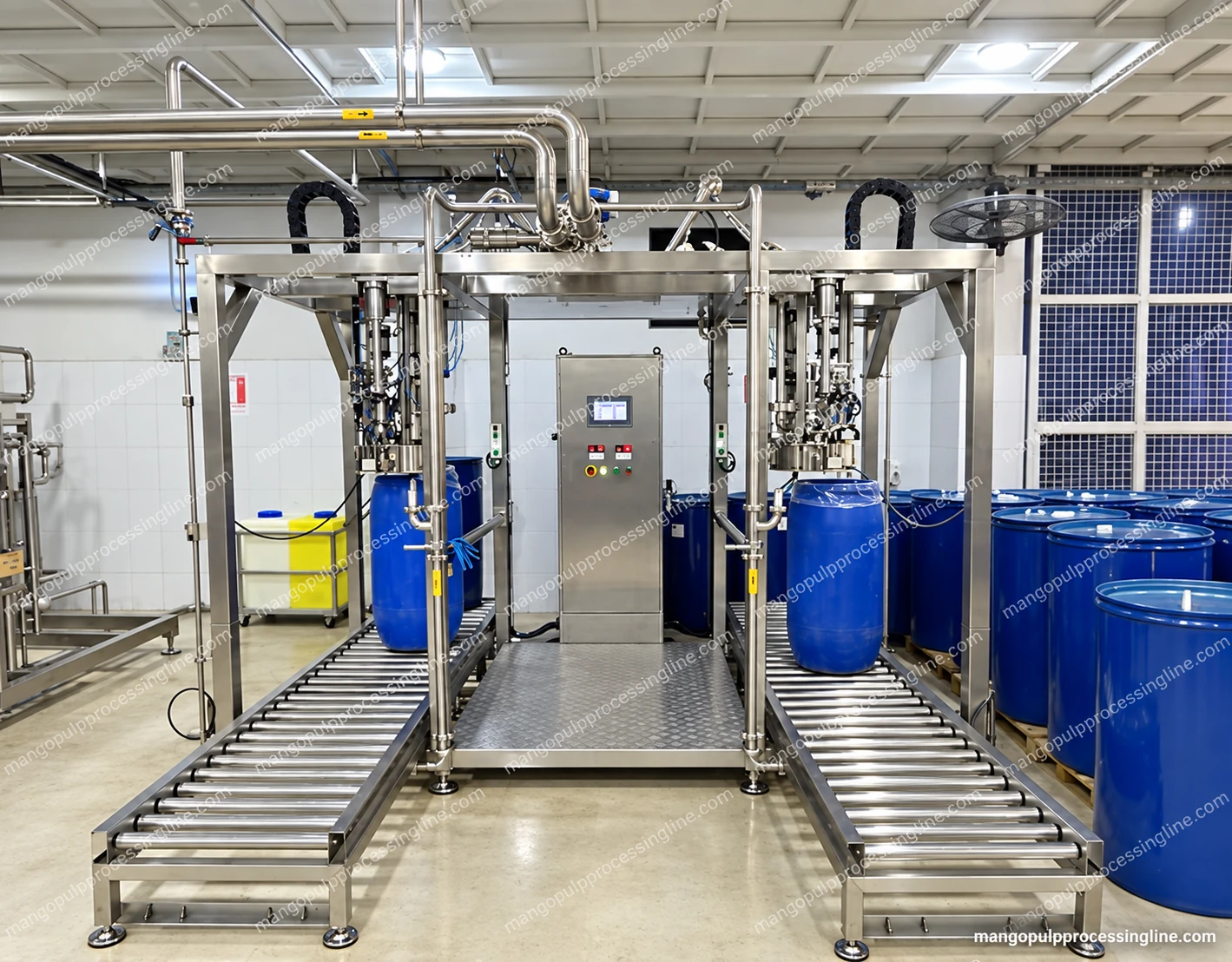
The photograph shows two filling positions above separate roller lanes. A twin-head layout allows container handling to be organised across the two stations; the operating sequence and usable filling rate depend on the supplied machine, bag and pulp duty.
Choose a bag format before assigning a filling rate
The equipment catalogue covers an aseptic-bag family range of 1–220 L with additional format options. That range does not mean one pictured head handles every volume or fitment. Bag capacity, metering method and cycle rate are specified for the chosen filler.
| Selection item | What must match |
|---|---|
| Bag and support container | Bag-in-drum or another specified supported format |
| Fitment | Bag opening and head interface |
| Quantity measurement | The metering arrangement selected for the machine |
| Product supply | Flow, temperature and pressure at the filler inlet |
| Handling sequence | Bag placement, connection, filling, closing and container removal |
| Hygienic interface | Upstream product route, filling head and cleaning/sterilization sequence |
Bulk bag filling in the reported Watani mango line
The manufacturer reports a double-head aseptic filler in the Watani Food Industries Company LTD mango line in Yemen, with 20 L and 200–220 L bag formats. The manufacturer’s April 2026 report describes a line receiving 5 t/h of fresh mango.
The raw-fruit intake of that line is not the filler’s product-flow rating. Fruit separation and any product conditioning occur before filling, so the filler is selected against the treated pulp that reaches it. The equipment photograph on this page is a manufacturer configuration reference, not identified as the Watani unit.
Coordinate the filler with the treatment system
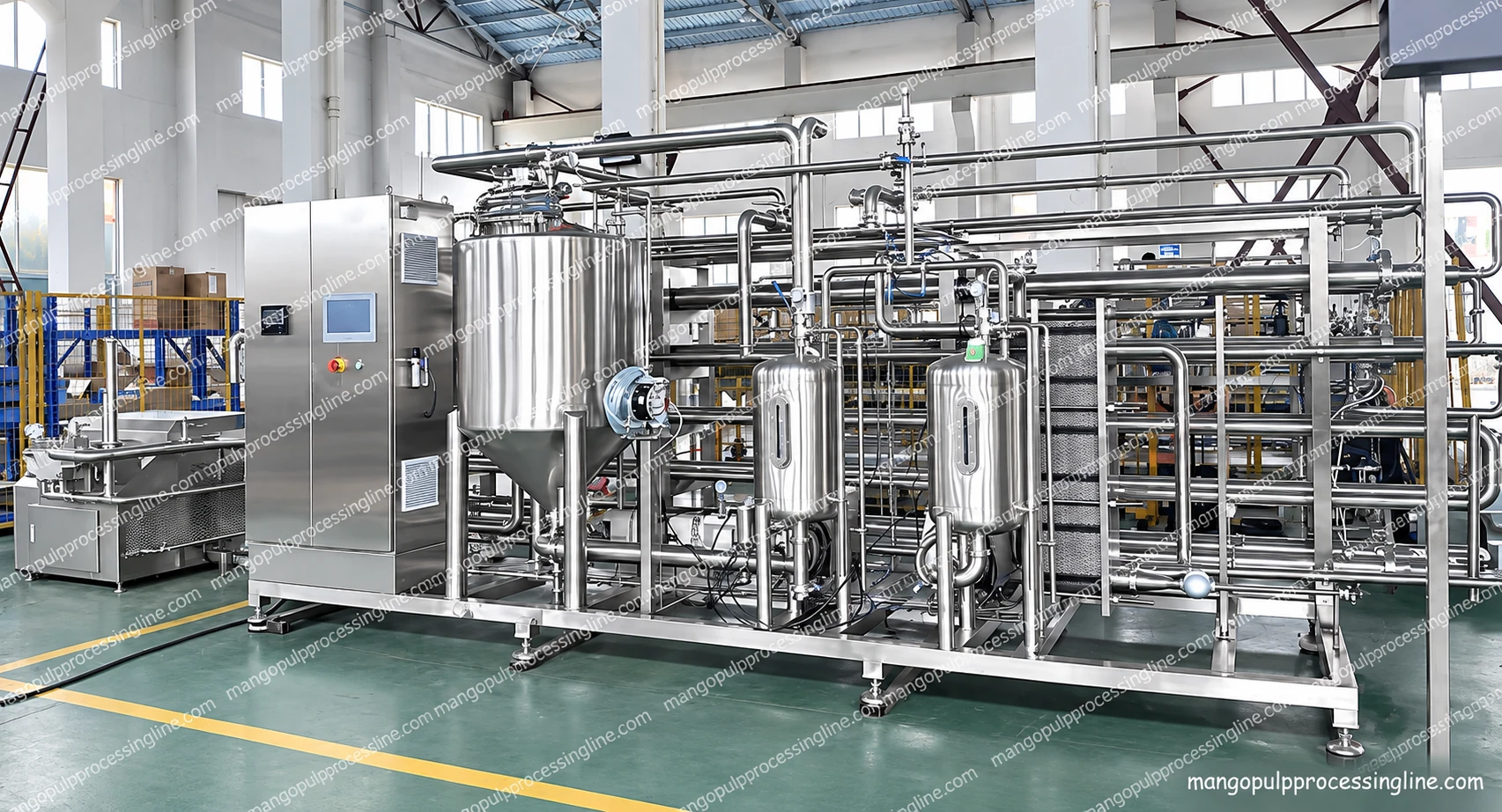
The downstream package connects the thermal outlet, transfer path and filling head. Its operating sequence defines when product can be admitted and how interruptions are handled. Cooling conditions, product flow and the filler’s ability to receive product need to agree.
Aseptic filling depends on that complete prepared route and the suitable packaging process. It is not a substitute for the upstream product treatment.
Keep head maintenance and cleaning practical
The installation needs access for handling bags, inspecting the head and fitment parts, and servicing seals and valves. The supplied instructions define the interventions that require stopping and preparing the filling system again.
The catalogue includes CIP/SIP-compatible configurations. Their scope covers the selected filling circuit and connection to the upstream equipment; tank and pipe cleaning elsewhere in the plant does not establish that the filler is ready for operation.
Common questions
Can the two-head photograph establish a bags-per-hour output?
No. Useful output depends on the selected bag quantity, product supply, filling sequence and container handling time. Those conditions are part of the filler specification.